



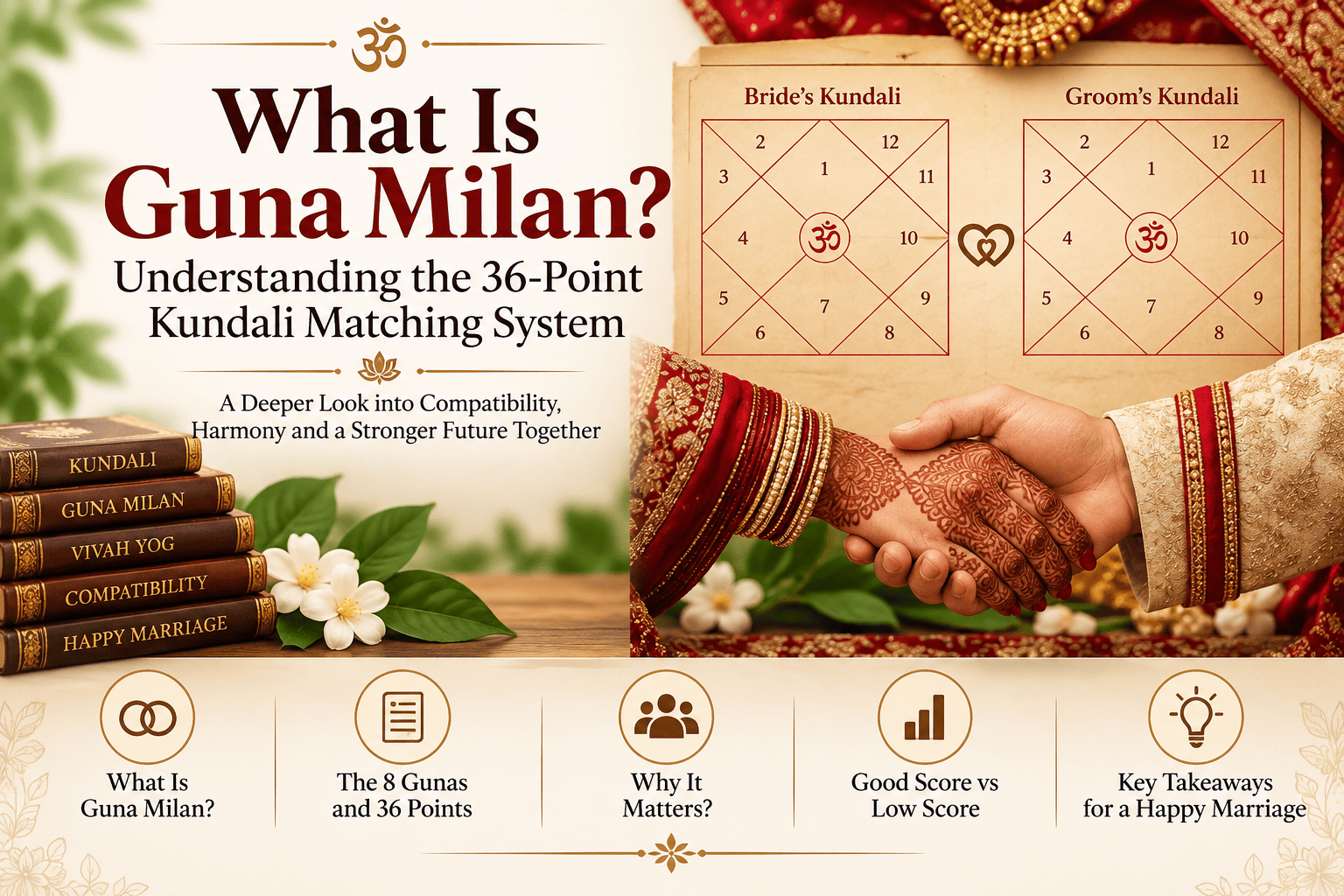
22 September 2026 What Is Guna Milan? Understanding the 36-Point Kundali Matching System
Marriage is an important life decision, and in Vedic astrology, Kundali matching is traditionally used to understand compatibility between two individuals. One of the most commonly discussed parts of this process is Guna Milan in Kundali.
Guna Milan evaluates different aspects of compatibility between two people’s birth charts. The traditional system considers eight important areas, known as Ashtakoota, with a maximum possible score of 36 Gunas. These factors cover temperament, communication, physical compatibility, health, family life, and overall harmony.
But what do these 36 points actually mean? Is a higher score always enough to determine compatibility? And how does the traditional Kundali matching 36 points system work?
Let us understand the process in a simple and practical way.
What Is Guna Milan in Kundali?
Guna Milan in Kundali is a traditional Vedic astrology method used to compare two individuals’ birth charts before marriage. The system is commonly known as Ashtakoota Milan because it evaluates eight different compatibility factors.
Each Koota carries a specific number of points, and together they total 36 Gunas. The purpose is to provide an astrological perspective on different dimensions of married life rather than relying on a single factor.
The eight areas considered in Guna Milan in Kundali are:
- Varna – 1 point
- Vashya – 2 points
- Tara – 3 points
- Yoni – 4 points
- Graha Maitri – 5 points
- Gana – 6 points
- Bhakoot – 7 points
- Nadi – 8 points
Together, these eight factors make up the traditional 36-point system.
How Does the 36-Point Guna Milan System Work?
The Kundali matching 36 points method assigns different weights to each Koota. Some factors receive fewer points, while others carry greater weight because they are traditionally considered significant in compatibility assessment.
The score from these factors often serves as an initial reference when comparing two Kundalis. However, do not view the number in isolation. A complete chart assessment may also consider other planetary placements and relevant Doshas.
Here is what the eight Kootas generally represent.
1. Varna – Spiritual and Value Compatibility
Varna carries 1 point in the traditional system. It reflects values, outlook, and broad spiritual or psychological compatibility.
It is one of the smaller components of the Kundali matching system, but it still contributes to the overall compatibility assessment.
2. Vashya – Mutual Influence and Understanding
Vashya carries 2 points. It is traditionally associated with mutual attraction, influence, and interpersonal dynamics.
This part of the Kundali matching system can indicate how two individuals may interact and respond to one another.
3. Tara – Well-Being and Compatibility
Tara carries 3 points and connects the birth stars, or Nakshatras, of the two individuals.
In traditional astrology, this factor is considered when assessing general well-being and the supportive nature of the match.
4. Yoni – Physical Compatibility
Yoni carries 4 points and is traditionally associated with physical attraction and intimate compatibility.
When considering guna matching for marriage, Yoni is one factor that can offer insight into the traditional astrological understanding of physical and instinctive compatibility.
5. Graha Maitri – Mental Compatibility
Graha Maitri carries 5 points and focuses on planetary friendship.
It is traditionally associated with mental connection, communication, understanding, and two individuals’ ability to relate to one another.
For this reason, Graha Maitri is an important component of Guna Milan in Kundali.
6. Gana – Nature and Temperament
Gana has 6 points and relates to the temperament and behavioural tendencies associated with the Nakshatras.
It provides an astrological perspective on how two individuals’ personalities and behavioural patterns may interact.
When evaluating guna matching for marriage, temperament can be an important area to understand because everyday compatibility involves communication, expectations, and different ways of responding to situations.
7. Bhakoot – Emotional and Life Compatibility
Bhakoot carries 7 points and is traditionally associated with emotional compatibility, family life, prosperity, and the broader direction of the relationship.
Bhakoot is therefore an important part of Guna Milan in Kundali, particularly when interpreting the overall relationship dynamics.
8. Nadi – Health and Family Considerations
Nadi carries the highest weight of 8 points.
Traditional Kundali matching 36 points analysis gives significant attention to Nadi because it is associated with health, well-being, and family-related considerations.
Nadi matching is also commonly discussed in relation to Nadi Dosha. However, a detailed interpretation should consider the complete Kundali rather than assuming that one factor alone determines the outcome.
What Does the Guna Milan Score Mean?
One of the most common questions about Guna Milan in Kundali is: “How many Gunas should match for marriage?”
Traditionally, 18 out of 36 points is often considered a basic reference point for compatibility. Scores above this level may traditionally be viewed as showing greater compatibility, while lower scores may require more detailed examination.
However, the Kundali matching system should not be reduced to a simple pass-or-fail score.
For example, two Kundalis may have a particular score but also include other planetary combinations relevant to the relationship. Similarly, a lower score does not automatically mean that marriage is impossible.
This is why Kundali matching 36 points should be understood as one part of a broader astrological assessment.
Why Is Guna Matching Important Before Marriage?
The main purpose of guna matching for marriage is to understand different dimensions of compatibility before making a major life decision.
A traditional Guna Milan assessment can help explore areas such as:
- Mental and emotional compatibility
- Temperament and behavioural differences
- Communication and mutual understanding
- Physical compatibility
- Family and relationship considerations
- Traditional health-related considerations
- Potential Doshas that may require further analysis
Instead of focusing only on the final number, couples and families can use the assessment as a starting point to understand the relationship’s strengths and areas that may need attention.
Is a High Guna Score Enough for Marriage?
A high score in the Kundali matching system can indicate stronger compatibility according to the factors included in the traditional scoring method, but it should not be treated as a guarantee of a successful marriage.
Similarly, a lower score does not necessarily mean that a relationship cannot work.
A more detailed astrological assessment may consider planetary positions, Manglik Dosha, Nadi Dosha, Bhakoot Dosha, the seventh house, its lord, Venus, Jupiter, and other relevant chart factors.
This broader approach can provide more context than simply looking at the final Guna score.
Guna Milan vs Complete Kundali Matching
Guna Milan vs Complete Kundali Matching
Guna Milan in Kundali primarily refers to the traditional Ashtakoota scoring system based on eight compatibility factors. Complete Kundali matching can go beyond these eight factors and examine additional planetary combinations and Doshas.
For example, if a couple has a particular Guna score, an astrologer may still examine other relevant aspects of both charts before interpreting the results.
Therefore, guna matching for marriage can be considered an important starting point, while complete Kundali analysis may provide a broader picture.
When Should Couples Consider Kundali Matching?
Traditionally, couples consider Kundali matching before marriage, whether the relationship is arranged or based on love.
Couples may consider an assessment when they want to understand traditional astrological perspectives on their compatibility, identify areas that may need attention, or discuss concerns about Doshas and other planetary factors.
The goal should be to gain perspective and understanding, not to make decisions based only on a numerical score.
How Can an Astrologer Help With Guna Milan?
Interpreting the Kundali matching system requires more than simply calculating the 36-point score.
An experienced astrologer can review the individual birth charts, explain the meaning of the different Kootas, discuss relevant Doshas, and provide context around the overall compatibility assessment.
At White Lotus Spirituality, Santosh Sharmaa Ji provides personalised Kundali matching consultations based on Vedic astrology. The service page explains the traditional eight-factor, 36-Guna approach and also discusses areas such as Mangal Dosha, Nadi Dosha, and Bhakoot Dosha.
Final Thoughts on Guna Milan
Guna Milan in Kundali is a traditional Vedic astrology method that evaluates compatibility through eight Kootas and a maximum score of 36 Gunas.
The Kundali matching 36 points system can provide a useful framework for understanding different areas of compatibility, including temperament, communication, physical compatibility, and traditional health and family considerations.
However, the final Guna score should not be treated as the only factor in deciding about marriage. The broader Kundali matching system can involve examining the complete birth charts and relevant planetary combinations.
If you want to understand your compatibility in greater detail, a personalised consultation can help you understand what your Guna score means in the context of your complete Kundalis.
Get Personalised Kundali Matching Guidance
Wondering what your Guna score means or whether the traditional compatibility factors support your relationship? At White Lotus Spirituality, you can consult the best kundali matching astrologer in India, Santosh Sharmaa Ji, for personalised Vedic astrology guidance.
Instead of relying only on an online score, get your Kundalis reviewed in context and understand the different compatibility factors, Doshas, and areas that may require attention.
Book your personalised Kundali Matching consultation today and get a deeper astrological perspective on your relationship.
Book Your Kundali Matching Consultation
A consultation can help you understand your charts more clearly and make relationship decisions with an informed perspective, rather than relying on a single Guna score.

Written by Dr. Santosh Sharma
Third-generation Vedic astrologer and former Air Force Wing Commander, trusted by 150,000+ clients worldwide for authentic, research-based astrological guidance.



The 36 points in Kundali matching come from eight Kootas: Varna, Vashya, Tara, Yoni, Graha Maitri, Gana, Bhakoot, and Nadi. Each Koota has a different point value, totalling 36 points.
Traditionally, 18 out of 36 Gunas is often used as a basic reference for compatibility. However, you shouldn't rely on the score alone. A complete Kundali analysis may examine other planetary positions and Doshas.
Guna Milan can provide an astrological perspective on compatibility, but it is not the only factor traditionally considered in Kundali matching. Other planetary combinations and relevant Doshas may also be reviewed for a broader assessment.
Guna matching for marriage is the traditional process of comparing two individuals' birth details to evaluate compatibility across eight areas through the Ashtakoota system.
The Kundali matching system is traditionally based on the Nakshatras and other birth-chart details of both individuals. The Ashtakoota method evaluates eight compatibility factors and assigns a maximum of 36 points.
No Comments